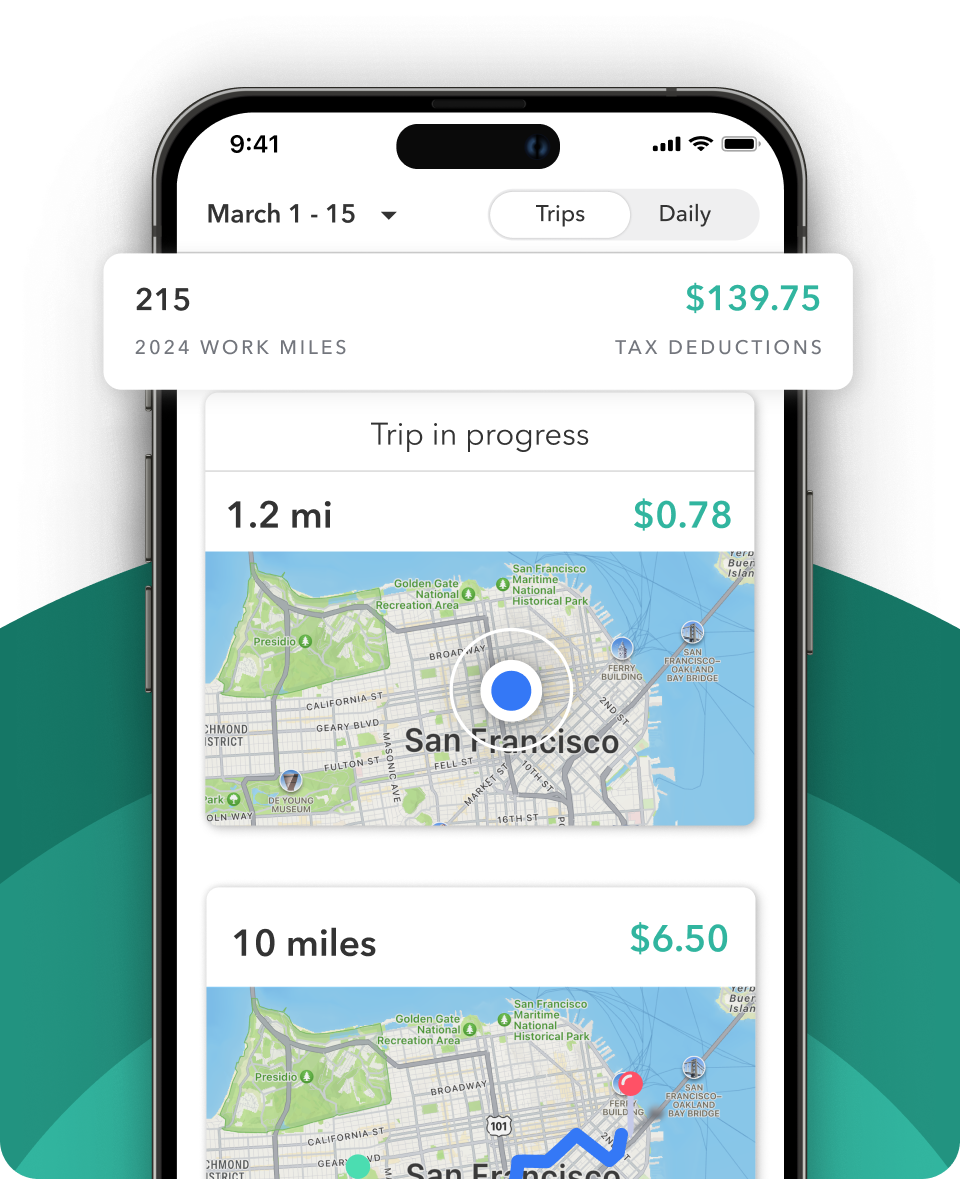
$13k+
Avg. annual deduction for high-mileage professionals
Mileage deductions are among the most valuable and most underclaimed tax breaks for the self-employed. Deduct every business mile at the IRS standard rate, but only with a compliant log. Rules, qualifying trips, requirements, and a savings calculator by industry.

Avg. annual deduction for high-mileage professionals
Self-employed users tracking miles with Everlance
IRS-compliant GPS-verified mileage logs
Every untracked mile is a deduction you can't claim back at tax time
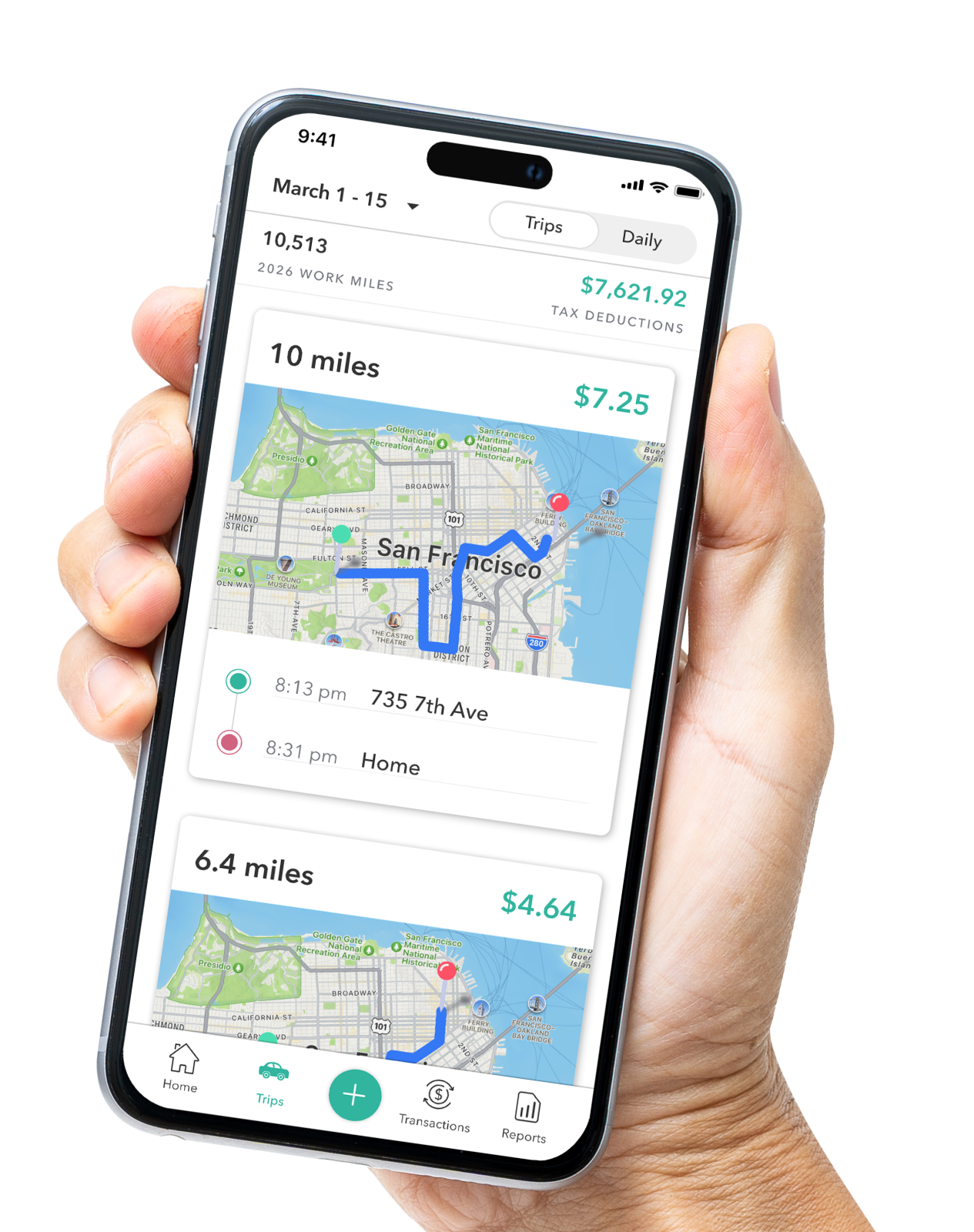
The IRS does not require a specific format for your mileage log β but it does require specific information. Every business trip you claim must be documented with four data points. Missing any one of them gives the IRS grounds to disallow your entire mileage deduction, even if every trip was completely legitimate.Now that we've covered the fundamentals, let's dive deeper into the various aspects of IRS mileage reimbursement.

Every entry must include the exact date the drive took place. The IRS cross-references claimed trips against permit records, MLS activity, client invoices, and platform logs β a missing or approximate date turns a valid deduction into an unverifiable one.
Log the specific address where each trip began and ended. GPS-captured coordinates carry the most weight in an audit because they are objective, timestamped, and virtually impossible to dispute. Entries that say only "office to client" without addresses are routinely challenged.

Every entry must include the exact date the drive took place. The IRS cross-references claimed trips against permit records, MLS activity, client invoices, and platform logs β a missing or approximate date turns a valid deduction into an unverifiable one.

Record the total miles for every individual trip not weekly or monthly totals. Automatic GPS tracking captures this at the trip level in real time, eliminating the need for odometer readings, manual math, or end-of-year estimates that the IRS may reject.

Every entry must include the exact date the drive took place. The IRS cross-references claimed trips against permit records, MLS activity, client invoices, and platform logs β a missing or approximate date turns a valid deduction into an unverifiable one.

Log the specific address where each trip began and ended. GPS-captured coordinates carry the most weight in an audit because they are objective, timestamped, and virtually impossible to dispute. Entries that say only "office to client" without addresses are routinely challenged.

Write a specific, descriptive note for every trip "buyer showing at 412 Oak St" or "drove to lumber yard for framing materials." Vague labels like "work," "job," or "client" do not meet IRS standards and will not survive scrutiny in an audit. The more specific the note, the stronger the deduction.

Record the total miles for every individual trip not weekly or monthly totals. Automatic GPS tracking captures this at the trip level in real time, eliminating the need for odometer readings, manual math, or end-of-year estimates that the IRS may reject.
The IRS does not require a specific format for your mileage log β but it does require specific information. Every business trip you claim must be documented with four data points. Missing any one of them gives the IRS grounds to disallow your entire mileage deduction, even if every trip was completely legitimate.Now that we've covered the fundamentals, let's dive deeper into the various aspects of IRS mileage reimbursement.

Every entry must include the exact date the drive took place. The IRS cross-references claimed trips against permit records, MLS activity, client invoices, and platform logs β a missing or approximate date turns a valid deduction into an unverifiable one.
Log the specific address where each trip began and ended. GPS-captured coordinates carry the most weight in an audit because they are objective, timestamped, and virtually impossible to dispute. Entries that say only "office to client" without addresses are routinely challenged.
Every entry must include the exact date the drive took place. The IRS cross-references claimed trips against permit records, MLS activity, client invoices, and platform logs β a missing or approximate date turns a valid deduction into an unverifiable one.

Record the total miles for every individual trip not weekly or monthly totals. Automatic GPS tracking captures this at the trip level in real time, eliminating the need for odometer readings, manual math, or end-of-year estimates that the IRS may reject.

Every entry must include the exact date the drive took place. The IRS cross-references claimed trips against permit records, MLS activity, client invoices, and platform logs β a missing or approximate date turns a valid deduction into an unverifiable one.

Log the specific address where each trip began and ended. GPS-captured coordinates carry the most weight in an audit because they are objective, timestamped, and virtually impossible to dispute. Entries that say only "office to client" without addresses are routinely challenged.

Write a specific, descriptive note for every trip "buyer showing at 412 Oak St" or "drove to lumber yard for framing materials." Vague labels like "work," "job," or "client" do not meet IRS standards and will not survive scrutiny in an audit. The more specific the note, the stronger the deduction.

Record the total miles for every individual trip not weekly or monthly totals. Automatic GPS tracking captures this at the trip level in real time, eliminating the need for odometer readings, manual math, or end-of-year estimates that the IRS may reject.
It's also worth understanding what the IRS means by "ordinary and necessary." A business drive qualifies when it serves a legitimate, recognizable purpose for your profession it does not need to be exceptional or rare. A real estate agent driving to a property showing, a contractor checking a job site, and a nurse commuting to a temporary facility assignment are all ordinary and necessary. The IRS does not require the drive to generate immediate revenue prospecting runs, estimating visits, and pre-contract site surveys all qualify as long as the business purpose is clear and documented.
One category that never qualifies: commuting. Driving from your home to a fixed, regular place of business Β like your brokerage, office, or home depot is treated as a personal commute regardless of how work-related your mindset is. The exception is a qualifying home office. If you have a dedicated workspace that meets IRS home office requirements, your driveway becomes the start of every deductible trip. This single distinction changes your deduction significantly and is worth discussing with your CPA if you work primarily from home.
Enter your estimated annual business miles and federal tax rate to see your potential mileage deduction and estimated tax savings for 2026.
Total Mileage Deduction
$13,413
18,500 mi Γ 72.5Β’
Estimated Tax Savings
$2,951
At 22% federal rate
Monthly Value
$246
Per month in savings
Start capturing every mile β free
Get startedBefore you file, you need to choose which method you'll use to calculate your vehicle deduction. The right choice depends on your vehicle, your mileage volume, and your record-keeping preferences.
|
Factor
|
Standard Mileage Rate
|
Actual Expense Method
|
|---|---|---|
| Record-keeping required | Mileage log only | Receipts for all vehicle costs |
| Best for high-mileage drivers | Usually produces larger deduction | Less effective at high mileage |
| Best for expensive vehicles | May be less optimal | Captures depreciation value |
| Flexibility to switch methods | Must choose first year | Cannot switch back once used |
| Simplicity | One number per mile | Requires itemizing all costs |
Most self-employed professionals β across every industry covered in this hub β benefit more from the standard mileage rate. It requires far less record-keeping and typically produces a larger deduction than calculating actual vehicle costs like fuel, insurance, registration, and depreciation. One critical rule: you must choose the standard mileage method in the first year you place a vehicle in business service. Once you use actual expenses, you generally cannot switch back. Consult a CPA in year one to make the right choice.
The most common questions self-employed professionals ask about IRS mileage deductions β answered clearly, without the tax jargon.
The IRS standard mileage rate for business use in 2026 is 72.5 cents per mile β the highest rate in recent years. As a self-employed photographer, you can deduct this amount for every mile driven for business purposes, including travel to client shoots, location scouting, equipment pickup, studio visits, and client meetings. The rate applies to sole proprietors filing Schedule C and to single-member LLCs treated as sole proprietorships. This is one of the most valuable and commonly overlooked deductions available to freelance photographers, and using it correctly can reduce your taxable income by thousands of dollars each year.
Yes. Travel from your home office or studio to client shoot locations is fully deductible at the 2026 IRS rate of 72.5 cents per mile. This includes weddings, portrait sessions, commercial shoots, events, headshots, newborn sessions, and any other client-related photography travel. If youβre shooting multiple locations in a single day β for example, a church ceremony followed by a reception venue β every leg of that trip is deductible. The IRS requires a contemporaneous mileage log documenting the date, destination, business purpose, and miles driven for each trip. A GPS tracking app like Everlance handles all of this automatically.
Yes. Location scouting trips are considered ordinary and necessary business expenses and qualify for the standard mileage deduction. As long as the primary purpose of the drive is business-related scouting for a client project or portfolio development, those miles are deductible at 72.5 cents per mile in 2026 β even if you ultimately donβt use the location. Log the trip with a note such as βscouted waterfront park for upcoming engagement sessionβ and youβre covered. The key test the IRS applies is whether the expense was ordinary for someone in your profession and necessary for conducting your business. Scouting clearly meets both criteria.
The average freelance photographer drives between 8,000 and 20,000 business miles per year, depending on their specialty and market area. At the 2026 IRS rate of 72.5 cents per mile, that translates to a total deduction of $5,800 to $14,500. At a 22% federal tax rate, that saves $1,276 to $3,190 annually in federal taxes alone, plus any applicable state tax savings. Wedding and commercial photographers who serve a wide geographic area and frequently travel between venues, studios, and client meetings tend to accumulate mileage at the higher end of this range. Portrait and studio-based photographers typically fall somewhere in the middle. Every mile you fail to track is money youβre giving back to the IRS.
Yes. Driving to pick up or return rented equipment, purchase supplies at a camera store, or transport gear to a repair shop all qualify as deductible business mileage. This includes trips to specialty photography retailers, big-box stores for batteries or memory cards, or online order pickup locations when the purchase is for your photography work. Keep a log noting the date, the store or vendor you visited, the purpose (e.g., βequipment rental pickup for corporate headshot sessionβ), and the miles driven. Everlance auto-captures all of this via GPS and lets you add a note to each trip in seconds directly from your phone β no spreadsheets required.
Commuting from your home to a regular studio location you rent does not qualify as deductible mileage β the IRS treats this as a personal commute, the same as any employee driving to a fixed workplace. Personal errands run during a business trip also do not qualify for the portion of the drive that is personal. If you have a legitimate home office that qualifies under IRS rules, however, travel from your home directly to a client location is generally deductible. Itβs also worth noting that meals and entertainment expenses are separate deductions subject to different rules and limits, and should not be included in your mileage log.
Yes, absolutely. The IRS requires contemporaneous records for mileage deductions. This means you must log each trip at or near the time it happens β not reconstruct them weeks or months later at tax time. Your log must include the date, starting and ending location, business purpose, and total miles for every trip. Without these records, your entire mileage deduction can be disallowed in an audit, even if the trips were 100% legitimate. A mileage tracking app like Everlance automatically captures all of this data using GPS the moment your vehicle starts moving. At year-end, you can generate a complete IRS-compliant mileage report in PDF or Excel format β ready to hand directly to your accountant or attach to your tax return.
Most freelance photographers benefit more from the standard mileage rate (72.5 cents per mile in 2026) because it requires significantly less record-keeping and often produces a larger deduction than tracking actual gas, insurance, depreciation, and maintenance costs individually. The actual expense method can sometimes yield a higher deduction for photographers who drive an expensive vehicle with high operating costs, but the administrative burden is considerably greater. There is one critical rule to know: you must choose the standard mileage method in the first year you use a vehicle for business. If you choose actual expenses first, you generally cannot switch back to the standard mileage rate for that vehicle in future years. When in doubt, consult your tax professional in the first year to choose the method that makes the most sense for your situation.

Get the latest 2026 IRS mileage rate, see how it compares to prior years, and learn how to apply it to your deductions correctly.

Healthcare workers drive more deductible miles than most realize. Here's what qualifies, what the IRS requires, and how much you could save.
Rideshare drivers log thousands of deductible miles every week. Here's what qualifies, what the IRS requires, and how much you could save.
Automatic GPS tracking captures every deductible mile and delivers your IRS-compliant report instantly.